what prompted president franklin d roosevelt to begin researching atomic energy
By Robert A. Rosenthal
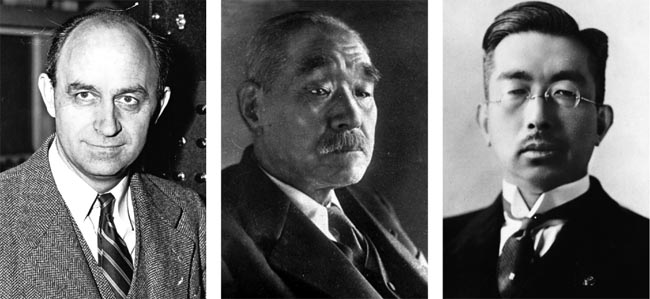
How did nosotros get to dropping an diminutive bomb on Hiroshima? Who was responsible? Where and when did it begin? The answers are complex, just the most direct link starts at a double squash court beneath the stands of Stagg Field, the University of Chicago's unused football stadium. At that unlikely place, at 3:53 pm on December 2, 1942, Enrico Fermi and his team of physicists achieved a cocky-sustaining nuclear chain reaction that released a controlled menses of free energy from the atomic nucleus. This confirmed Albert Einstein's 1905 special theory of relativity, which states that mass and energy are equivalent, a human relationship expressed past the most famous equation in history: e = mc2.
On January thirty, 1933, the president of Germany, Paul von Hindenburg, yielded to political pressure level and appointed Adolf Hitler chancellor. Hitler moved immediately to legalize anti-Semitism and abolish the civil rights of German Jews. Within two months, the Nazis launched a national boycott of Jewish businesses, dismissed judges and lawyers from their practices, and incited attacks on Jews in the streets.
The First Stride Toward the Age of Nuclear War: Albert Einstein Immigrates to America
Considering of this political climate, the globe'due south most famous physicist, Albert Einstein, emigrated later that year to America, where he accepted a professorship at Princeton Academy's Found for Advanced Study. Five years later on, in December 1938, High german physicist Otto Hahn stunned the scientific world by announcing that he and his research team had split the uranium atom, a process later designated nuclear fission. The possible uses of fission every bit a weapon and the awareness that the Germans possessed knowledge of this process alarmed the many scientists who had escaped from Nazi-occupied Europe. They feared the consequences of what would happen if Hitler's scientists should develop such a weapon. Einstein's best friend, physicist Leo Szilard, who also left Germany soon later on the Nazis came to power, tried unsuccessfully to push U.S. authorities officials to begin an atomic enquiry programme.
Finally, in August 1939, Szilard convinced Einstein to transport a letter to President Franklin D. Roosevelt urging him to qualify a U.South. atomic research and evolution program. Prompted past Einstein'south letter of the alphabet, Roosevelt ordered the War Department to put together a top secret "Uranium Committee" to investigate the use of atomic fission in weaponry. Eventually, this led to the establishment of the Manhattan Project, which was to exist led by Brig. Gen. Leslie Groves, who had simply been transferred from overseeing the construction of the Pentagon.
The bulk of the project's work was to be accomplished at three major facilities in the United states of america: bomb design was to be carried out at Los Alamos, New Mexico; the uranium separation process was assigned to a gaseous-diffusion plant in Oak Ridge, Tennessee; and nuclear reactors located in Hanford, Washington, were to produce plutonium.
Uranium, or Plutonium?
Uranium has several isotopes, which are chemically identical in form but different in the number of neutrons they contain. Naturally occurring uranium ore contains almost 99 percent uranium U-238 and seven-tenths of one percent of uranium U-235. But U-235 is easily fissionable, that is, hands converted into energy when bombarded by neutrons. Separation of uranium into U-238 and U-235 is a slow and hard process, and by early July 1945 only 110 pounds of fissionable U-235 had been delivered to Los Alamos—not enough to brand a flop. Plutonium, which is closely related to uranium, can also be used to brand nuclear weapons, just unlike uranium, virtually any combination of isotopes tin can be used, and it tin be produced in big quantities in a nuclear reactor past bombarding uranium with neutrons. It was decided, and then, to employ uranium in the first bomb, then switch to plutonium for hereafter bombs.
A uranium bomb is unproblematic to make—build a gun that fires a subcritical mass of U-235 at another subcritical mass of U-235. When they slam together, they create a critical mass, and in a few microseconds, a fission chain reaction occurs that releases a huge amount of energy. Plutonium, however, emits and then many spontaneous neutrons that the chain reaction starts to occur prematurely as the two subcritical masses approach each other, and a small explosion occurs earlier the mass becomes critical. This event is called a fizzle. With plutonium, a and then-called gun-type flop would not work, then the scientists had to develop a different approach for the plutonium bomb.
They came upwardly with a scheme that used conventional explosives to crush a sphere of fissionable plutonium into a smaller and denser sphere. When the fissionable atoms are packed closer together, the rate of neutron capture is increased, and the mass becomes critical. This happens much faster than with the gun method.
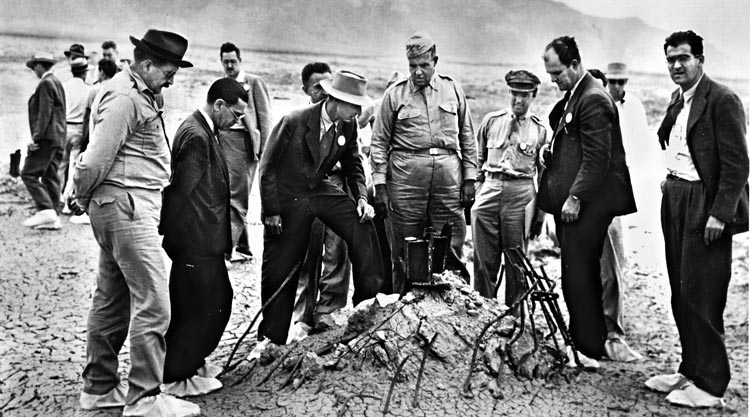
Because of the complexity of amalgam an implosion-type weapon, information technology was decided that a total-scale exam was needed to prove the concept. This exam was codenamed Trinity and planned for mid-July 1945 at a small Ground forces airfield in Alamogordo, New Mexico, 250 miles southward of Los Alamos. On July xvi, the flop named Fat Man (because of its size) was hoisted to the peak of a 100-foot steel tower, where it exploded at 5:xxx am with an energy equivalent to about twenty,000 tons of TNT.
The 1945 Potsdam Conference and the Trinity Test
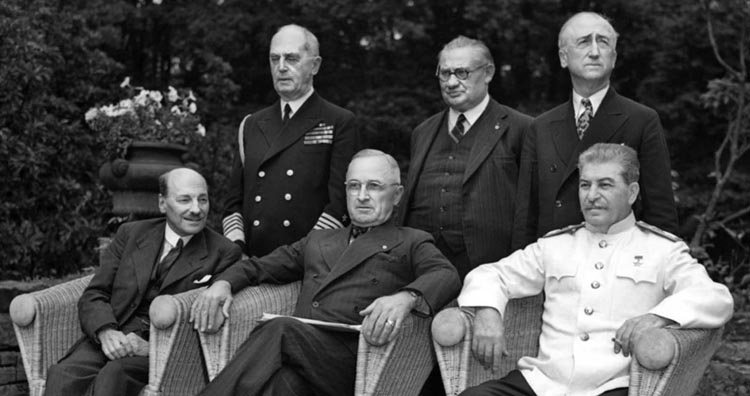
Potsdam is a small suburb of Berlin gear up amid many lakes and rivers. In mid-July 1945, it was the site of the third meeting of the Big Iii Allied powers: the U.s.a., Britain, and the Soviet Union. Much had inverse in the 5 months since the earlier meeting at Yalta in the Crimea. Nazi Germany had been defeated two months earlier, Roosevelt had died and was replaced by Vice President Harry Truman, and Winston Churchill'south Conservative Party was voted out of office in favor of the Labor Party, headed past Prime Government minister Clement Atlee.
The conference was planned to begin on the morning of July 16, but the Soviet premier, Josef Stalin, was late due to an apparent mild heart assault the previous day, so the meeting began on July 17.
President Truman had received a report of the successful Trinity test the day before.
Uplifted by the Trinity written report, Truman reportedly told Secretary of War Henry L. Stimson that information technology gave him an entirely new feeling of confidence. Even Churchill later wrote that when Truman got to the meeting after reading the written report, he was a changed man. "He told the Russians merely where they got on and off, and generally bossed the whole meeting." That night, Truman wrote to his wife Bess, "We'll end the war a year sooner at present, and call back of the kids who won't be killed."
The coming together concluded with a long list of conditions, including determining postwar borders in Europe, punishing Nazi war criminals, German war reparations, and the Potsdam Declaration. This last document defined the terms for the Japanese surrender and was signed by Truman, Churchill, and Chiang Kai-shek, chairman of the Nationalist authorities of Prc. Stalin did not sign it, every bit the Japanese-Soviet Non-Aggression Pact of 1941 had kept Russia from declaring state of war on Japan upwardly to that signal.
Of import aspects of the annunciation included the demand for "unconditional surrender and prosecution of those in say-so who take deceived and misled the people of Nippon into embarking on world conquest." The Japanese interpreted these ambiguous phrases to hateful destruction of the imperial organisation and the likelihood that Emperor Hirohito would be tried as a war criminal and executed. To the Japanese people, the hanging of the emperor would be comparable to the crucifixion of Christ.
The Potsdam Proclamation was sent to Japan via shortwave broadcast in 20 languages on July 27. All regular programs were cancelled to allow full and repeated broadcasts of the announcement, which was non delivered through diplomatic channels.
Mokusatsu: Japan Answers America's Need for Surrender
The post-obit morning, Japanese Prime Government minister Kantaro Suzuki convened the Supreme State of war Council, consisting of the top vi members of the government who effectively ruled Japan in 1945. These men adopted a procedural dominion regarding give up that required consummate unanimity among them to reach a decision. Suzuki explained the positive shift he saw from the unconditional surrender demand called for earlier to the unconditional surrender of the armed forces, which he believed indicated the preservation of the imperial construction. Not all of the quango members were willing to accept this nuanced divergence, and later that day Suzuki held a press briefing in which he rejected the declaration by treating it with silent contempt, or mokusatsu. That evening, the Japanese-run Hong Kong News called the declaration a slice of unqualified impudence.
Ix days subsequently, on the forenoon of August six, Suzuki learned of the dropping of the first atomic flop (codenamed Little Boy) on Hiroshima.
Never in its history had the United States collectively hated an enemy every bit it hated Japan. While U.S. propaganda took pains to differentiate betwixt evil Nazi leaders and good Germans, no such distinction was made among the Japanese, who were portrayed equally vermin, cockroaches, and rats. They were considered less than human, so the determination to drop the flop did non trigger moral qualms near killing civilians.
Although Truman never questioned the utilise of the bomb, there were other members of the U.S. government and armed services did. Full general Douglas MacArthur, supreme commander of the Southwest Pacific Theater of operations, considered the flop completely unnecessary from a armed forces bespeak of view, since, as he believed, the Japanese were already beaten. Others argued for dropping a demonstration bomb in Tokyo Bay or in the body of water off the eastward declension of Japan.
Arguments Against Dropping the Atomic Bomb on Japan (with Casualties every bit Counterargument)
In that location were three main arguments confronting using the bomb. First, the Japanese were rapidly losing the power to sustain military operations. They had little food, no oil, no steel, a dwindling navy, and an almost nonexistent air force. In short, they appeared ready to give up.
Second, Stalin promised Roosevelt at the Yalta Conference in February 1945 that he would be fix to set on the Japanese in Manchuria three months after the defeat of Nazi Germany. It was believed that this second forepart would quickly bring about the Japanese give up.
Last was the moral and upstanding consequence of deliberately targeting civilians. Both sides had done this in Europe, and since early March, American Boeing B-29 Superfortress heavy bombers had been burn-bombing Tokyo, killing hundreds of thousands of civilians, merely the prospect of bombing with the atomic bomb seemed unlike.
Proponents of dropping the bomb on Japanese cities responded by citing the increasing number of U.Due south. casualties with each successive isle invasion. During the battle for Saipan and Tinian, June 15, 1944, 11,957 men were wounded and 3,752 were killed—a casualty total of 15,709. On Iwo Jima, Feb 19, 1945, there were 26,038 casualties—19,217 wounded, 6,821 killed. The invasion of Okinawa, April 1, 1945, saw 55,162 wounded and 12,520 killed for a total of 67,682 casualties.
In the last 3 major battles, full casualties increased dramatically from xv,000 to 67,000. If Nippon did not surrender soon and information technology became necessary to invade the home islands, information technology was estimated that U.S. casualties could arroyo a million men. Many analysts believed that even this prediction was depression.
Debate over how costly an invasion would have been has raged for decades. However, the 1940 census of Japan showed 73 million people with 23 million males over the historic period of 15, and that does not include women. Near all of them were able to shoot a gun or wield a sword or a sharpened stick.
The most compelling reason to driblet the flop and hopefully avoid invading Nippon was the Japanese soldier's observance of bushido, confirmed in the battle for Saipan. Bushido was the code of moral principles that samurai were required to observe, and it had long been central to Japanese war machine life. It adult in the 9th century and stressed frugality, loyalty, mastery of martial arts, and award unto death.
Japanese war machine planners much preferred decisive battles on the beaches of the homeland. At worst, these tactics would save laurels in defeat. At all-time, they believed the Americans would reject this invasion strategy because the price in homo casualties would be as well much to pay. To underscore their resolve, Nippon's War Guidelines Quango approved a resolution in Hirohito'due south presence calling for supreme self-sacrifice and the honorable expiry of 100 meg men, women, and children. With suicide engrained in their culture, it appeared that the unabridged state had embraced the imagery of national salvation through mass suicide, a willingness to dice for their homeland that dwarfed anything in history.
Just they were not unyielding ideologues. Japan'southward leaders were in fact quite savvy and aware of their difficult position. They were holding out for strategic reasons, their business organization being not so much whether to finish the conflict, only how to end information technology, hold onto territory, avoid war crimes trials, and preserve the imperial system. It was non lost on Japanese leaders that war crimes trials were about to begin in Frg, and hanging the emperor was a existent possibility.
Their hope was to convince the Soviet Wedlock, which was still uncommitted to fighting in Asia, to mediate a settlement with the Americans. They calculated that Stalin would negotiate more than favorable terms in exchange for Japanese-held territory in Asia.
To impress the Japanese hierarchy that the U.s. possessed an arsenal of super bombs and not just one experimental weapon, American leaders planned on delivering a second bomb soon after the first 1 was dropped. Since Little Boy was the but i of its kind in existence, the 2d would accept to exist a plutonium device like the Trinity prototype.
In early 1944, it was decided that the United States would establish a base of operations in the Northern Mariana Islands, including Saipan, Tinian, and Guam, 1,500 nautical miles from Tokyo. Although the U.s. did not have an aircraft with that range, prototypes of the B-29 were under evolution. In July 1944, the islands were occupied past U.S. forces, and Tinian was chosen every bit the bomber base.
Two B-29s and two pilots were selected to deliver the bombs. The showtime, scheduled for August 6, 1945, was the Enola Gay, piloted by 32-year-old Colonel Paul Tibbetts and named for his female parent. The second, named Bockscar, was to depart three days after Baronial 9, allowable by 26-year-old Major Charles Sweeney.
The 2 fissionable uranium-235 segments of Little Male child were shipped separately in two Douglas C-47 send planes from Albuquerque, New Mexico, to San Francisco, California, where one function was loaded onto the ill-fated heavy cruiser USS Indianapolis for its journey to Tinian. The other part, the "bullet," was sent past air on a Douglas C-54 cargo plane from San Francisco to Hawaii, and and then to Tinian, where information technology was unloaded on July 25. By July 27, everything had arrived at the bomb-assembly building at Tinian'due south North Field.
It was and then discovered that the ground clearance of the B-29's flop bay doors was too low to arrange the 28-inch diameter of Picayune Boy along with its transport dolly. A nine-foot-deep loading pit was dug, the bomb was rolled into the pit, and a hydraulic lift hoisted it into the bomb bay of the plane. Loading the flop was frail, and the fit was tight, only it worked in the end.
The Target Listing for Little Male child
A target list of iv cities was prepared. These cities had been largely untouched during nightly bombing raids against Japan, and an accurate assessment of the weapon's damage could be made. Hiroshima was selected every bit the primary target of the first nuclear bombing mission. At 2:45 am on August six, Colonel Tibbets started his takeoff roll on Tinian'south North Field for the vi-hour flight to Japan.
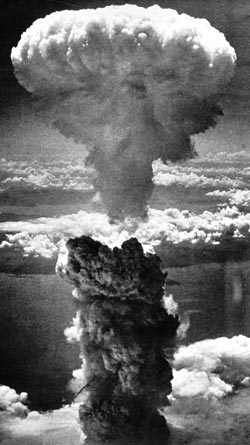
The release at viii:15 am Tokyo time went as planned, and Little Male child, with 140 pounds of U-235, took 43 seconds to fall from the aircraft, which was flight at 31,000 anxiety, to the detonation distance of ane,800 anxiety. The atomic age had arrived, and the world would exist inverse forever.
News of Hiroshima did not reach Tokyo for well-nigh a day, non until the following morning, because the bomb had wiped out all advice inside the urban center.
Prime Minister Suzuki was awakened at iv am and informed of the Hiroshima attack. He immediately called members of the Supreme War Council to schedule an emergency meeting merely was told they were too decorated to meet.
For some time, there was a faction in the Japanese regime that wanted to enlist Russia to negotiate an end to the war with the United states. The onerous terms of the Potsdam Annunciation added more impetus to this try.
In that location was a partitioning between the civilian and the military members of the Supreme State of war Quango, although one military member, Admiral Mitsumasa Yonai, sided with the civilians. The civilians looked at the atomic bomb as an opportunity to surrender without shame, but the admirals and generals still hated unconditional give up and refused to concord.
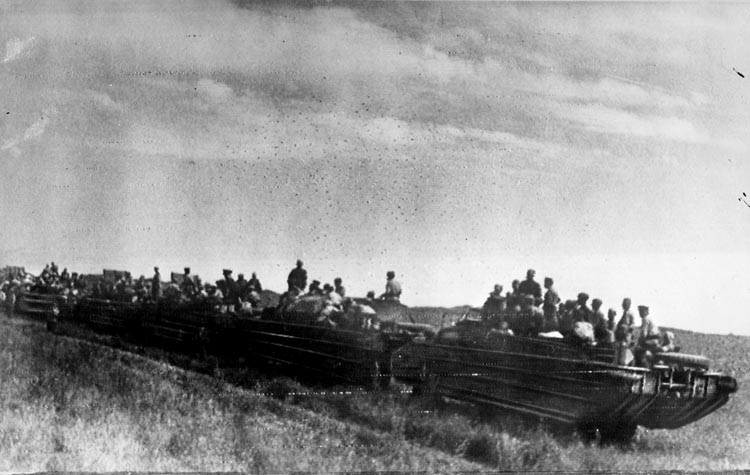
Since late July, the Japanese ambassador to Russia, Naotake Sato, had attempted to get a meeting with Soviet strange government minister Vyacheslav Molotov in order to get a reading on Stalin'due south attitude toward helping with peace negotiations. Japanese foreign minister Shigenori Togo nevertheless clung to the hope that the war could be ended through Moscow's intervention, and he continued to press Administrator Sato to meet with Molotov. Finally, Molotov agreed to run across Sato at eight pm on August 8. All policy makers in Japan were now waiting for Molotov'southward reply.
The previous day, however, Molotov had moved the time of the meeting forward three hours to 5 pm. At the appointed time, Sato arrived at the Kremlin and was ushered into Molotov's study. Molotov started to read from a newspaper that announced the Soviet Wedlock would declare war on Nippon, effective that evening at midnight. Sato was shocked and asked Molotov if he could transport a coded cablevision earlier midnight to his regime about the declaration of war, but Molotov blocked the transmission lines, and the news never reached Tokyo.
Sato, however, did not catch the of import ambiguity that was intentionally omitted from the Soviet declaration of war. Sato assumed that war would begin at midnight on August eight, Moscow fourth dimension. However, the sly Stalin meant it to be midnight in the Transbaikal fourth dimension zone, where the invasion of Manchuria would begin, half-dozen hours ahead of Moscow time. This explains why Molotov moved the meeting with Sato from eight pm to v pm, which is 11 pm in Manchuria, simply one hour from the start of the Soviet invasion. Therefore, Stalin declared state of war on Japan before the invasion but ensured that by the time the announcement was made public, the invasion would already be an achieved fact.
It was not until early the following morning, Baronial 9, that Prime Minister Suzuki received this startling news. Past this time, reports of Soviet troop incursions into Japanese-held Manchuria were being received. Suzuki immediately scheduled a State of war Council meeting for ten:30 am to discuss terms of a possible surrender.
The council debated all day, and though the Soviet proclamation made clear the hopelessness of their situation, the armed services faction refused to admit defeat. Fifty-fifty after news arrived during the tardily morning that Nagasaki had as well been bombed with a nuclear weapon, that stunning development could not break the deadlock and did not have much impact on the group.
Japan Offers its Give up
The War Council agreed to convene a full cabinet coming together at 2:thirty pm, merely by x that nighttime they still had not reached understanding, and they invited the emperor to requite his divine opinion.
Hirohito arrived at the coming together ten minutes before midnight. By 2 am, now August x, he agreed to a surrender, but but on the condition that the monarchy be retained. Four hours later, at 6:45 am, this news was sent to Bern, Switzerland, and Stockholm, Sweden, the two neutral countries through which communications betwixt Japan and the Allies were existence made.
At 4:10 pm that day, Foreign Minister Togo met with the Soviet administrator to Japan, Jacob Malik, where the two made ane of the most baroque exchanges of official messages in the annals of war. Malik handed Togo a declaration of state of war, and Togo handed Malik an offer of surrender.
The Japanese offer of surrender was non well received in Washington. Secretary of Country James Byrnes reminded others that Roosevelt and Churchill had insisted on unconditional give up since 1943. Byrnes said that if whatsoever weather were to be accepted, he wanted the The states and its Allies to provide them, not Japan.
Byrnes was authorized to draft a reply to Japan'south offer, which took a harder position well-nigh the emperor than Truman did. The response, however, could non exist sent to Japan until the Allies canonical it.
The next day, August 11, the Centrolineal response was handed to the Swiss chargé d'affaires in Washington. The machinery of peacemaking footing slowly through the international bureaucracies, so the Japanese Foreign Ministry did not receive Washington'southward response until one am on Dominicus morning, August 12.
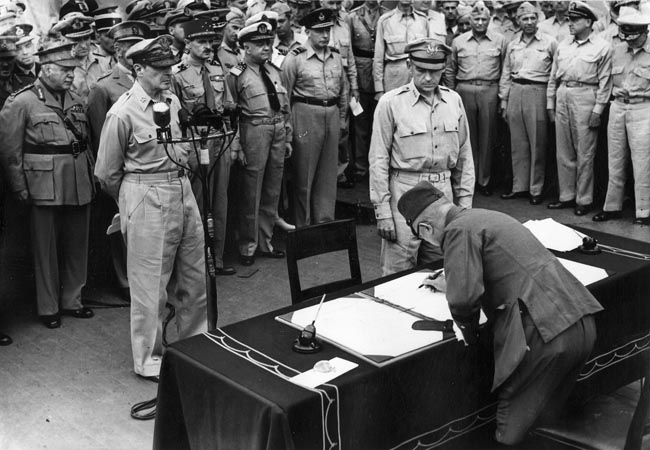
For three days, members of the Supreme War Council debated the response. Finally, on August 14, the Emperor intervened and announced his conclusion to accept the Potsdam atmospheric condition. He scheduled a session that evening to tape a surrender spoken language that would be broadcast to the Japanese people the post-obit day. At the same time, Japan's credence of unconditional surrender was sent to Washington.
At noon on August xv, many Japanese heard the emperor's high-pitched vox for the outset time. He announced, "The authorities has been instructed to accept the terms of the Potsdam Declaration." This message created confusion in the minds of many listeners, who were at present unsure whether or not Japan had actually surrendered. Adding to the confusion was the poor audio quality of the radio broadcast and the formal, ladylike linguistic communication in which the spoken communication was composed.
Hirohito explained that the reason for Japan'due south surrender was because of the enemy's utilise of a new and roughshod bomb that could take many innocent lives. Although the action of the Japanese War Council made it clear that the surrender was triggered by Russia'southward declaration of war, it was not mentioned in Hirohito's speech.
The war was over, but there were many unanswered questions.
What Was the Real Reason that Japan Surrendered?
It is commonly believed that the awesome devastation of the atomic bombs caused the Japanese regime to capitulate. The traditional story of Japan's surrender has a simple timeline. On Baronial 6, 1945, the United States dropped an atomic bomb on Hiroshima. Three days afterward, it dropped another on Nagasaki. The side by side day, August 10, the Japanese indicated their intention to surrender considering of these bombs. This is the version of events that has been told by historians for more than than 70 years, but if the clock is considered in addition to the calendar, a different story unfolds.
What was the real reason that Japan surrendered? Was information technology the atomic bombs or Russia'southward entry into the war in Asia? If it was the Hiroshima flop, why did Prime Minister Suzuki look almost three days later on he learned of information technology in the early forenoon of August 7 earlier he convened a meeting of the Supreme War Quango on August ix?
The reason could not have been the Nagasaki bomb, because he learned of this outcome in the late morning of August nine, later on the quango had begun meeting to discuss surrender. It was clear that he had scheduled the meeting earlier he learned of Nagasaki just about immediately later on he received give-and-take that the Soviet Wedlock had declared war on Japan. However, Hirohito made no mention of the Soviet Union's action in his speech communication to the nation. The explanation is that both Japan and the United States had strong reasons to perpetuate the myth that Japan was forced to surrender because of the diminutive bombs.
Hirohito was faced with two choices. He could admit that he and his advisors had failed badly and led his nation through a disastrous war with eighty percentage of its cities destroyed, hundreds of thousands of its people killed, and the residue facing starvation. Or, he could blame the loss on an amazing scientific breakthrough that no one could accept predicted. The bomb was the perfect explanation for losing the war.
This story served the interests of the U.s.a. too. If the bomb was responsible for winning the state of war, the perception of U.South. military ability would be enhanced, its diplomatic influence in the world would exist strengthened, and the billions of dollars spent on the bomb and the Manhattan Project would be justified.
Importantly, if the Soviet entry in the war was avant-garde as the existent reason Japan surrendered, then Stalin could claim that he had been able to do in four days what the The states had been unable to do in four years, and the perception of Soviet armed forces power and diplomatic skills would exist greatly improved.
If the flop did not motivate Nihon to surrender, perhaps it was not necessary to use it. Maybe the bomb did nothing to accelerate Japan'south surrender. A growing number of historians believe that Japan would have surrendered if the United States had merely waited four days until the Soviets entered the war. [This question remains controversial more than 75 years after the surrender of Japan.]
Today, the Enola Gay is housed in the National Air and Space Museum at Washington Dulles Airport and Bockscar in the National U.S. Air Force Museum in Dayton, Ohio, while the runways of Tinian'south Due north Field accept been relegated to the dustbin of history.
World War Ii is considered by many to be the well-nigh significant event in human history. It was certainly the bloodiest, with an estimated 70 to lxxx million people killed. The enormous scope of the war is almost incommunicable to sympathize in hindsight. Vast areas of Europe, Asia, the Pacific, and Due north Africa were devastated, and its influence touched every part of the planet. (To become an in-depth look at how the 2nd World War shaped the time to come of the globe, subscribe to WWII History magazine.)
For more than l years, Bob Rosenthal was an builder specializing in the blueprint and development of healthcare facilities. Today, he is an independent filmmaker whose current project is a documentary nigh the cease of Globe State of war 2 in the Pacific that was filmed on Tinian Isle. He lives with his wife in Del Mar, California.
Source: https://warfarehistorynetwork.com/2020/10/27/why-the-u-s-dropped-the-atomic-bomb-on-japan-in-wwii/
0 Response to "what prompted president franklin d roosevelt to begin researching atomic energy"
Postar um comentário