Prime Reading Book About Neighbors Son Who Goes Missing
 | |
| Author | Marking Haddon |
|---|---|
| Country | United Kingdom |
| Language | English and 36 others[1] |
| Genre | Mystery novel |
| Publisher | Jonathan Cape (UK) Doubleday (US) Anchor Canada (Canada) |
| Publication appointment | May 1, 2003 |
| Media type | Print (hardback and paperback) |
| Pages | 274 |
| ISBN | 0-09-945025-9 |
| OCLC | 59267481 |
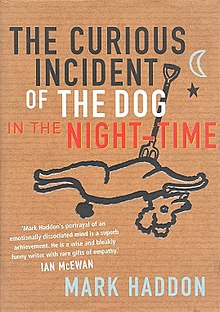
The Curious Incident of the Dog in the Night-Time is a 2003 mystery novel by British writer Marker Haddon. Its title refers to an observation by the fictional detective Sherlock Holmes (created by Arthur Conan Doyle) in the 1892 brusk story "The Hazard of Silver Blaze". Haddon and The Curious Incident won the Whitbread Volume Awards for Best Novel and Volume of the Year,[2] the Democracy Writers' Prize for Best First Volume,[iii] and the Guardian Children's Fiction Prize.[4] Unusually, it was published simultaneously in split editions for adults and children.[v]
The novel is narrated in the first-person perspective by Christopher John Francis Boone, a fifteen-yr-old male child who is described as "a mathematician with some behavioural difficulties" living in Swindon, Wiltshire. Although Christopher'southward condition is not stated, the book'due south blurb refers to Asperger syndrome, high-functioning autism, or savant syndrome. In July 2009, Haddon wrote on his blog that "The Curious Incident is non a book near Asperger's...if anything it's a novel about departure, about being an outsider, almost seeing the world in a surprising and revealing way. The book is not specifically most any specific disorder", and that he, Haddon, is not an expert on autism spectrum disorder or Asperger syndrome.[half-dozen]
The volume uses prime number numbers to number the chapters, rather than the conventional successive numbers. Originally written in English, it has been translated into 36 additional languages.[1]
Plot [edit]
Christopher John Francis Boone is a xv-yr-old boy who has behavioural bug and lives with his father, Ed. He explains in his narration that his mother, Judy, died two years before. Then one solar day, the boy discovers the expressionless body of the neighbour's canis familiaris, Wellington, speared past a garden fork. Mrs. Shears, the dog'south owner, calls the police, and Christopher comes under suspicion. He is arrested, so released with a police caution. He decides to investigate the dog'due south death. Throughout his adventures, Christopher records his experiences in a book. During his investigation, Christopher meets the elderly Mrs. Alexander, who informs Christopher that his mother had an matter with Mr. Shears.
Ed discovers the book and confiscates it. While searching for the confiscated book, Christopher discovers letters from his mother dated after her supposed death. He is then shocked that he is unable to move. Ed realizes that Christopher has read the letters. He confesses that he had lied nearly Judy's death; he too admits that he had killed Wellington, after an argument with Mrs. Shears. Christopher decides to run away and live with his female parent.
Later a long and event-filled journeying, evading policemen and feeling ill from the trains and crowds around him, he finally finds his way to the home of his female parent and Mr. Shears. Judy is delighted that Christopher has come to her. Mr. Shears does not desire Christopher living with them. Very shortly after arriving, Christopher wants to return to Swindon in order to take his mathematics A-level. His mother leaves Mr. Shears, their relationship having broken downwards because of the rejection of Christopher by Mr. Shears. Afterward an argument with Ed, she agrees to let him see Christopher for daily cursory visits. Christopher remains terrified of his male parent and hopes Ed will be imprisoned for killing Wellington.
The story ends with Ed getting Christopher a puppy and promising that he will rebuild trust with Christopher slowly. Christopher asserts that he volition accept farther exams and attend academy. He completes his mathematics A-level with top grades. The book ends with Christopher optimistic near his time to come, having solved the mystery of the murdered canis familiaris, gone to London on his own, plant his female parent, written a book almost his adventures, and achieved an A in exams.
Characters [edit]
- Christopher John Francis Boone
- The protagonist and narrator of the novel, who investigates the murder of Mrs. Shears' dog Wellington, a large black poodle, has many behavioural problems.
- Ed Boone
- Christopher's male parent, a boiler engineer. Prior to the beginning of the story, he has been living with Christopher equally a single parent for two years.
- Judy Boone
- Christopher's female parent. Early on in the book, Christopher writes that she died of a eye attack two years before the book'south events.
- Sandy
- Christopher's Gilt Retriever puppy, bought for him by Ed at the finish of the book to rebuild trust betwixt them.
- Siobhan
- Christopher's paraprofessional and mentor at school. She teaches him how gild works and how to behave within its complex guidelines.
- Eileen Shears
- The owner of Wellington. She had attempted to panel Ed for a time after Christopher learns of his mother's decease.
- Roger Shears
- Mrs. Shears's ex-married man, who had an affair with Christopher's mother.
- Mrs. Alexander
- An old lady, who is one of Christopher'south neighbours, who offers information to help Christopher's investigation regarding his parents and Mr. and Mrs. Shears.
- Mr. Jeavons
- Christopher's psychologist.
- Rhodri
- Ed Boone's employee.
- Toby
- Christopher'south pet rat.
- Wellington
- Mrs. Shears' large blackness Poodle, which Christopher finds dead in her garden, with a garden fork sticking out of him.
Themes [edit]
[edit]
In an interview with NPR's Terry Gross, broadcast on her program Fresh Air in June 2003, Haddon said about Christopher:
If he were diagnosed, he would be diagnosed every bit having Asperger's syndrome, which is a form of autism. I suppose yous'd call it loftier-function autism, in that he can role on, you know, a day-to-mean solar day basis, in a kind of rudimentary way. But he has a serious difficulty with life in that he actually doesn't empathize with other human beings. He can't read their faces. He can't put himself in their shoes. And he can't sympathize anything more than the literal meaning of whatever'southward said to him, although I'm very conscientious in the volume not to actually utilize the word 'Asperger'due south' or 'autism' ... Because I don't want him to be labelled, and because, equally with most people who take a inability, I don't retrieve it's necessarily the most important affair nearly him ... And as a good friend of mine said later reading the volume, a friend who is himself a mathematician, it's non a novel about a male child who has Asperger's syndrome; information technology'south a novel virtually a immature mathematician who has some foreign behavioural problems. And I call up that's right. ... I take to say honestly that I did more than enquiry about the London Hugger-mugger and the inside of Swindon Railway Station, where some of the novel takes place, than I did nearly Asperger's syndrome. I gave him kind of 9 or 10 rules that he would live his life by, and so I didn't read whatever more well-nigh Asperger's because I recollect at that place is no typical person who has Asperger's syndrome, and they're as large and diverse a grouping of people equally whatsoever other group in society. And the of import thing is that I did a lot of imagining, that I did a lot of putting myself into his shoes in trying to brand him come up alive as a man beingness rather than getting him right, whatever that might mean.[7]
Haddon states on his website that, although he had read "a handful of newspaper and magazine manufactures about, or past, people with Asperger's and autism" in grooming for writing the volume, he knows "very little" nigh Asperger's syndrome and that Christopher Boone is inspired by ii different people. According to Haddon, none of these people can be labelled equally having a disability. Haddon added that he 'slightly regret[s]' that the term Asperger's syndrome appeared on the cover of his novel.[half-dozen] In 2010, in an interview with The Independent, he was described as "at present thoroughly irritated that the give-and-take Asperger'south appeared on subsequent editions of the novel, because now everyone imagines that he is an expert and he keeps getting phone calls asking him to appear at lectures".[8]
In a critical essay on the novel, Vivienne Muller quotes some praise by experts on disability theory: "In its presentation of Christopher's everyday experiences of the society in which he lives, the narrative offers a rich sheet of experiences for an ethnographic report of this detail cognitive status, and one which places a positive spin on the syndrome. The reader in this case acts every bit ethnographer, invited to see what Mark Osteen claims is a 'quality in autistic lives that is valuable in and of itself'.[9] Along like lines, [Alex] McClimens writes that Haddon's novel is 'an ethnographic delight' and that 'Haddon's achievement is to have written a novel that turns on the central grapheme's divergence without making that difference a stigmatising characteristic".[ten] Muller adds that the novel "works with a stiff sense of the disabled speaking subject area, drawing readers into Christopher'due south cognitive / corporeal space through an incremental layering of his perspectives and reactions ... The narrative likewise bristles with diagrams, maps, drawings, stories, texts that inform Christopher's dictionary for mapping significant in a world of bewildering signs and sounds." She also admires such elements as "the digressive stream-of-connectedness-and-disconnectedness mode in which Christopher writes and thinks; the obsessive focus on minutiae; his musings about why animals behave the style they do; his quasi-philosophizing on death and life and the afterlife; his ambition to be an astronaut ..."[xi]
In a survey of children'southward books which "teach most emotional life", Laura Jana wrote: "On the one hand, this is a story of how an undeniably quirky teenage boy clings to social club, deals with a family unit crisis, and tries to make sense of the world as he sees it. But it as well provides profound insight into a disorder – autism – that leaves those who take it struggling to perceive even the most basic of human emotions. In so doing, The Curious Incident leaves its readers with a greater appreciation of their own ability to feel, express, and interpret emotions. This mainstream literary success made its manner to the pinnacle of The New York Times bestseller listing for fiction at the same time information technology was being touted by experts in Asperger's syndrome and autism-spectrum disorders as an unrivaled fictional depiction of the inner workings of an autistic teenage boy."[12]
Metaphor [edit]
Christopher often comments on his inability to appreciate some metaphors. He gives as an case a quote that he institute in "a proper novel": "I am veined with fe, with silverish, and with streaks of mutual mud. I cannot contract into the firm fist which those clamp who do not depend on stimulus." Haddon told Terry Gross, "Funnily enough, it'south really a quote from Virginia Woolf. It's Virginia Woolf on an off day, in the middle, I call up, of The Waves. An author whom I dearest actually, but who sometimes got a little too carried away."[7]
Multimodality [edit]
The novel is developed in various semiotic modes or resources: maps, diagrams, pictures, smileys, and the like, which are not ornamental but crucial to the agreement of the novel. This ways that Haddon's novel can be conceived every bit multimodal.[13]
Reception [edit]
Awards [edit]
The book was joint winner of the 2004 Boeke Prize, won the 2003 Whitbread Book of the Year laurels and sold more two million copies.[viii] Haddon also was ane of the winners of the 2004 Alex Awards, which "honor the 10 height adult books with appeal for adolescents."[14]
As well as winning the Guardian Children'southward Fiction Prize, Haddon earned the Book Trust teenage fiction award.[v] [15] The Curious Incident of the Dog in the Dark-Time was also long-listed for the Man Booker Prize, and "many observers were surprised that it did not advance to the shortlist." John Carey, chairman of the Booker console of judges, told The Guardian, "We have several clashes of opinion among the judges but I constitute Haddon's book about a boy with Asperger'south syndrome breathtaking."[fifteen]
Critical reaction [edit]
A survey in Swell Britain, conducted by the BBC'south literacy campaign for World Volume Day, found Curious Incident to exist amid "the superlative v happy endings, as voted on by readers" in novels (the others were Pride and Prejudice, To Kill a Mockingbird, Jane Eyre and Rebecca, the terminal of which Curious outranked).[16]
School Library Journal praised information technology every bit a "rich and poignant novel".[17] The San Jose Mercury News said: "Haddon does something audacious here, and he does information technology superbly. He shows us the way consciousness orders the world, even when the globe doesn't want to be ordered", calculation that "the great accomplishment of this novel is that it transcends its obvious cleverness. It's more than an exercise in narrative ingenuity. Filled with humor and pain, it verges on profundity in its test of those things—customs, habits, language, symbols, daily routines, etc.—that simultaneously unite and divide man beings."[18] A reviewer for The Christian Century described information technology as "an absorbing, plausible book": "The reader becomes absorbed not merely in the mystery of a murdered domestic dog and a missing mom, merely also in the mysterious world of an autistic child."[19]
A reviewer for The Atlanta Periodical-Constitution wrote that the story is "a touching evolution, one that Haddon scripts with tenderness and care... a unique window into the heed of a boy who thinks a little differently, but similar many kids his age, doesn't quite know how to feel."[twenty] Professor Roger Soder called information technology "visceral" and a "delightful story", declaring, "All of u.s. in our Spokane Book Club are special didactics professionals and so have considerable experience with kids with this disability, and we found the story believable."[21]
In 2019, the book was ranked 19th on The Guardian 's list of the 100 best books of the 21st century.[22]
Medical professionals' reviews [edit]
Alex McClimens, whom Muller quoted in a higher place, too wrote: "This magnificent essay in communication is compulsory reading for anyone with the slightest involvement in autistic spectrum disorders. This volume is also required reading for those who simply relish a fascinating story... we are offered a commencement person narrative to friction match anything by contemporary writers. Mark Haddon has created a true literary grapheme and his handling of the teenage Asperger'southward heroic adventure is brilliantly crafted. He uses the literal mind-set of his hero to mask the true management of the plot."[23] Reviewer Paul Moorehead calls the volume "a fairly ripping adventure story" and writes: "It's also quite a feat of writing. The actual use of linguistic communication is somewhat austere—an unavoidable consequence of having a boy with autism as a narrator— just it has its ain beauty, and it works. So persuasive so constructive is the structure of Christopher, not only is he a grapheme yous're rooting for, he's also the graphic symbol in the story you understand the best. It'due south startling how believably and comfortably this story puts you into what you might have thought were likely to be some pretty alien shoes."[24]
Reviewer David Ellis, naming The Curious Incident an "ambitious and innovative novel", wrote that Haddon "manages to avert the opposing pitfalls of either offending people with autism and their families or turning Christopher into an object of pity. Instead of becoming the focus of the plot the autism enhances information technology. The unemotional descriptions amplify many moments of observational comedy, and misfortunes are made extremely poignantly." He concludes that Christopher'southward story is "far more enjoyable and likely to stay with you lot for far longer than any medical textbook".[25]
Challenges [edit]
The Curious Incident of the Dog in the Night-time has ofttimes been challenged due to offensive linguistic communication, unsuited for age group, and religious viewpoint.[26] On the American Library Association's lists of the virtually banned and challenged books, the volume landed the 51st spot between 2010 and 2019,[27] too as the fifth spot in 2015.[26]
Adaptations [edit]
Stage [edit]
A stage adaptation, by Simon Stephens and directed by Marianne Elliott,[28] premiered at the National Theatre on two August 2012.[29] It starred Luke Treadaway equally Christopher, Nicola Walker as his mother Judy, Paul Ritter as his father Ed, Una Stubbs as Mrs Alexander and Niamh Cusack every bit Siobhan.[xxx] The product, which ran until late October, was broadcast live to cinemas worldwide on half dozen September through the National Theatre Live programme.[31]
The production transferred to the Apollo Theatre in Shaftesbury Avenue, London, from March 2013. On 19 Dec, during a performance, parts of the ceiling fell down, injuring around 80 of the over 700 patrons inside.[32] It re-opened at the Gielgud Theatre on 24 June 2014.[33] The new West End cast was led past Graham Butler as Christopher Boone, with Sarah Woodward as Siobhan, Nicolas Tennant equally Ed, Emily Joyce equally Judy, Gay Soper equally Mrs Alexander, Vicky Willing equally Mrs Shears and Daniel Casey as Mr. Shears. In 2015 the cast was Sion Daniel Young every bit Christopher Boone, with Rebecca Lacey every bit Siobhan, Nicolas Tennant as Ed, Mary Stockley as Judy, Jacqueline Clarke as Mrs Alexander, Indra Ové as Mrs Shears, Stephen Beckett as Roger Shears, Matthew Trevannion as Mr Thompson, Pearl Mackie equally No. twoscore/Punk Girl, Sean McKenzie as Reverend Peters and Kaffe Keating plays alternate Christopher. They were joined by Marker Rawlings, Penelope McGhie, Naomi Said and Simon Victor.[34]
An adaptation and translation into Spanish by María Renée Prudencio played at the Teatro de los Insurgentes in Mexico Urban center in June 2014. The graphic symbol of Christopher was played by Luis Gerardo Méndez and by Alfonso Dosal on alternate days. An Israeli adaptation (translation into Hebrew by Daniel Efrat) has been staged at the Beit Lessin Theater in Tel Aviv since March of the same year, starring Nadav Netz as Christopher; in 2015, Netz won the All-time Actor category at the Israeli Theater Awards for his operation.[35]
An adaptation and translation into French by Dominique Hollier premiered at the Théâtre de la Tempête in Paris, directed by Philippe Adrien, running from September 11 through 18 October 2015. It too ran at Théâtre Le Moderne, in Liege, Kingdom of belgium, direction by Daniel Henry-Smith, from 28 April through 13 May 2017.
An adaptation and translation into Danish by Christian Bundegaard premiered at the Odense Teater, September 2019, starring Kristoffer Helmuth as Christopher.
The Production volition begin a tenth ceremony UK & Republic of ireland tour at Troubadour Wembley Park Theatre on Saturday the 20th of November 2021.
Film [edit]
The film rights for the novel were optioned past Brad Greyness and Brad Pitt for Warner Brothers.[36] [37] In 2011 Steve Kloves was fastened to write and direct the project, but as of 2021 information technology has non nonetheless been produced.[38] [39] [40]
A Bengali-English adaptation of the novel has been filmed by Sudipto Roy called Kia and Cosmos, with the gender roles of the characters reversed, and the plot centering around the killing of a cat chosen Creation.[41]
References [edit]
- ^ a b "The Curious Incident of the Cat in the Night-Time". Worldcat. Retrieved eleven April 2020.
- ^ "Ethan Frome" (PDF). Archived from the original (PDF) on 9 October 2007. Retrieved 21 November 2010.
- ^ "2004 Commonwealth Writers Prize Awarded". State Library of Victoria. 15 May 2004. Archived from the original on 27 March 2011. Retrieved 28 May 2013.
- ^ The Guardian Children'southward Fiction Prize 2003 (meridian page). guardian.co.uk. half dozen Baronial 2012.
- ^ a b Ezard, John (13 November 2003). "Curious incident of writer's literary lid trick: Whitbread list means Haddon could exist three time winner". The Guardian. London: Guardian News and Media. Retrieved 21 April 2013.
- ^ a b "Asperger's & Autism". Marker Haddon. Archived from the original on 25 August 2018. Retrieved 29 December 2020.
- ^ a b Terry Gross interviewing Marking Haddon (26 June 2003). Children's book writer and illustrator Mark Haddon (interview) (sound). NPR. Event occurs at two:25 minutes in. Retrieved 30 November 2018.
- ^ a b "Mark Haddon: The Curious Incident of the Novelist Turned Playwright". The Contained. UK. 31 March 2010. Retrieved 21 November 2010.
- ^ cited in [S.] Adams (2005) p. 1
- ^ cited in [S.] Adams (2005) p. 24
- ^ Muller, Vivienne (December 2006). "Constituting Christopher: Disability theory and Mark Haddon'due south The Curious Incident of the Canis familiaris in the Night-fourth dimension". Papers: Explorations into Children's Literature. 16 (2): 118 ff.
- ^ Jana, Laura A. (February 2005). "Feelings 101: Teaching almost emotional life through literature". Gimmicky Pediatrics. 22 (ii): 87.
- ^ Mussetta, Mariana (8 Nov 2014). "Semiotic Resources in The Curious Incident of the Dog in the Night-Time: The Narrative Ability of the Visual in Multimodal Fiction". MATLIT: Materialidades da Literatura. two (one): 99–117. doi:x.14195/2182-8830_2-1_5. ISSN 2182-8830.
- ^ "Adult Books that Appeal to Teens". Reading Today. 22 (1): 7. August–September 2004.
- ^ a b Sarvas, Mark (27 January 2004). "The Curious Incident of the Dog in the Dark-Fourth dimension". The Mod Give-and-take. Archived from the original on two April 2013. Retrieved 21 April 2013.
- ^ "Happy Endings". Reading Today. 23 (5): iv. April–May 2006.
- ^ "Haddon, Mark. The Curious Incident of the Dog on Night-Time". School Library Journal. Vol. l, no. 4. April 2004. p. S64.
- ^ Matthews, Charles (22 June 2003). "Narrator is Autistic – Reasoning is Artistic". San Jose Mercury News.
- ^ "The Curious Incident of the Dog in the Night-Time". The Christian Century. Vol. 122, no. 25. 13 December 2005. p. 23.
- ^ Freeman, John (29 June 2003). "BOOKS: Whodunit Unveils Autistic Boy's Listen". The Atlanta Periodical-Constitution.
- ^ Soder, Roger (June 2005). "Books for Summer Reading". Phi Delta Kappan. 86 (10): 777. doi:ten.1177/003172170508601012. S2CID 220181469.
- ^ "The 100 best books of the 21st century". The Guardian. 21 September 2019. Retrieved 22 September 2019.
- ^ McClimens, Alex (May 2005). "The Curious Incident of the Dog in the Dark-Fourth dimension (Developed version)". Learning Inability Exercise. 8 (iv): 24.
- ^ Moorehead, Paul (25 April 2006). "Comfortable in Alien Shoes". Canadian Medical Association Periodical. 174 (nine): 1307–1308. doi:10.1503/cmaj.060083. PMC1435967.
- ^ Ellis, David S. J. (February 2004). "The Curious Incident of the Dog in the Night-fourth dimension". Student BMJ. 12: 84.
- ^ a b admin (26 March 2013). "Top x Most Challenged Books Lists". Advancement, Legislation & Issues . Retrieved 19 June 2021.
- ^ KPEKOLL (9 September 2020). "Peak 100 Most Banned and Challenged Books: 2010-2019". Advancement, Legislation & Bug . Retrieved 19 June 2021.
- ^ "The Curious Incident of the Dog in the Dark-Time – Cast & Creative". NationalTheatre.org.uk.
- ^ "The Curious Incident of the Dog in the Night-Fourth dimension". NationalTheatre.org.britain. Archived from the original on 31 March 2012.
- ^ Geoghegan, Kev (5 Baronial 2012). "National Theatre adapts Marker Haddon's Curious Incident". BBC News. BBC News Online. Retrieved 29 March 2013.
- ^ "Alive Homepage". National Theatre. Retrieved xv June 2012.
- ^ "London'south Apollo Theatre'due south roof collapses". BBC News. 19 December 2013. Retrieved 8 Jan 2016.
- ^ "The Curious Incident of the Dog In The Night-Time continues at the Gielgud Theatre". LondonTheatre1. 16 October 2014. Retrieved 12 Baronial 2021.
- ^ "Production images for The Curious Incident of the Canis familiaris in the Dark-Time". LondonTheatre1. 23 June 2015. Retrieved 12 August 2021.
- ^ "המקרה המוזר של הכלב בשעת לילה". Retrieved vii December 2020.
- ^ Thompson, Bill (26 June 2003). "Actress shows off her knack for one-act". The Post and Courier. Charleston, South Carolina.
- ^ Connelly, Brendon (24 April 2011). "Wonderful Novel The Curious Incident of the Dog in the Dark Time Being Adapted into a Film by Harry Potter Writer". Haemorrhage Cool. Retrieved 29 March 2013.
- ^ Stanley, Alessandra (2012). "The Curious Incident of the Domestic dog in the Night-Time". Movies & Tv Dept. The New York Times. Archived from the original on 2 March 2012. Retrieved 21 November 2010.
- ^ "Guardian and Observer Flick Season 2010'due south Power 100: David Heyman". The Guardian. 24 September 2010. Retrieved 19 Oct 2010.
- ^ The Curious Incident of the Dog in the Dark Fourth dimension at IMDb
- ^ "Kia And Creation Is A 'Whodunit' That Works At Many Levels". Film Companion. 4 April 2019. Retrieved 2 March 2021.
External links [edit]
- Interview by Dave Weich with author Mark Haddon – Powell's Books (October 10, 2006)
- The Curious Incident of the Dog in the Nighttime-Fourth dimension at Google Books
Source: https://en.wikipedia.org/wiki/The_Curious_Incident_of_the_Dog_in_the_Night-Time
0 Response to "Prime Reading Book About Neighbors Son Who Goes Missing"
Postar um comentário